
Less time managing product work. More time building great product.

Fijord takes care of the work around product management — so you can focus on the decisions that actually require you.


Google
Amazon
Meta
Darktrace
Publix

Early users include current and former employees of these companies

Less managing. More building.

Connect your tools, predict what matters, ship, and learn from every release.

One product memory

One product memory

Every call, doc, ticket, and metric builds one shared memory.

Backed by evidence

Backed by evidence

Every insight links back to its source.

Ask your product anything

Ask your product anything

Get clear answers grounded in your product data.

See what’s emerging

See what’s emerging

Signals surface as evidence builds.

See what needs attention

See what needs attention

Blockers, approvals, risks, and opportunities—prioritized in one place.

Capture your intuition

Capture your thoughts

Save an idea the moment you have it.

Turn evidence into work

Turn context into work

Draft briefs, epics, and tickets, then sync them to Jira or Linear.

Automate the follow-through

Automate the follow-through

Set a command once. Fijord keeps it running.

Built for speed

Built for speed

Hotkeys everywhere. Nothing breaks your flow.

Close the loop

Close the loop

Compare predicted impact with actual results after every release.
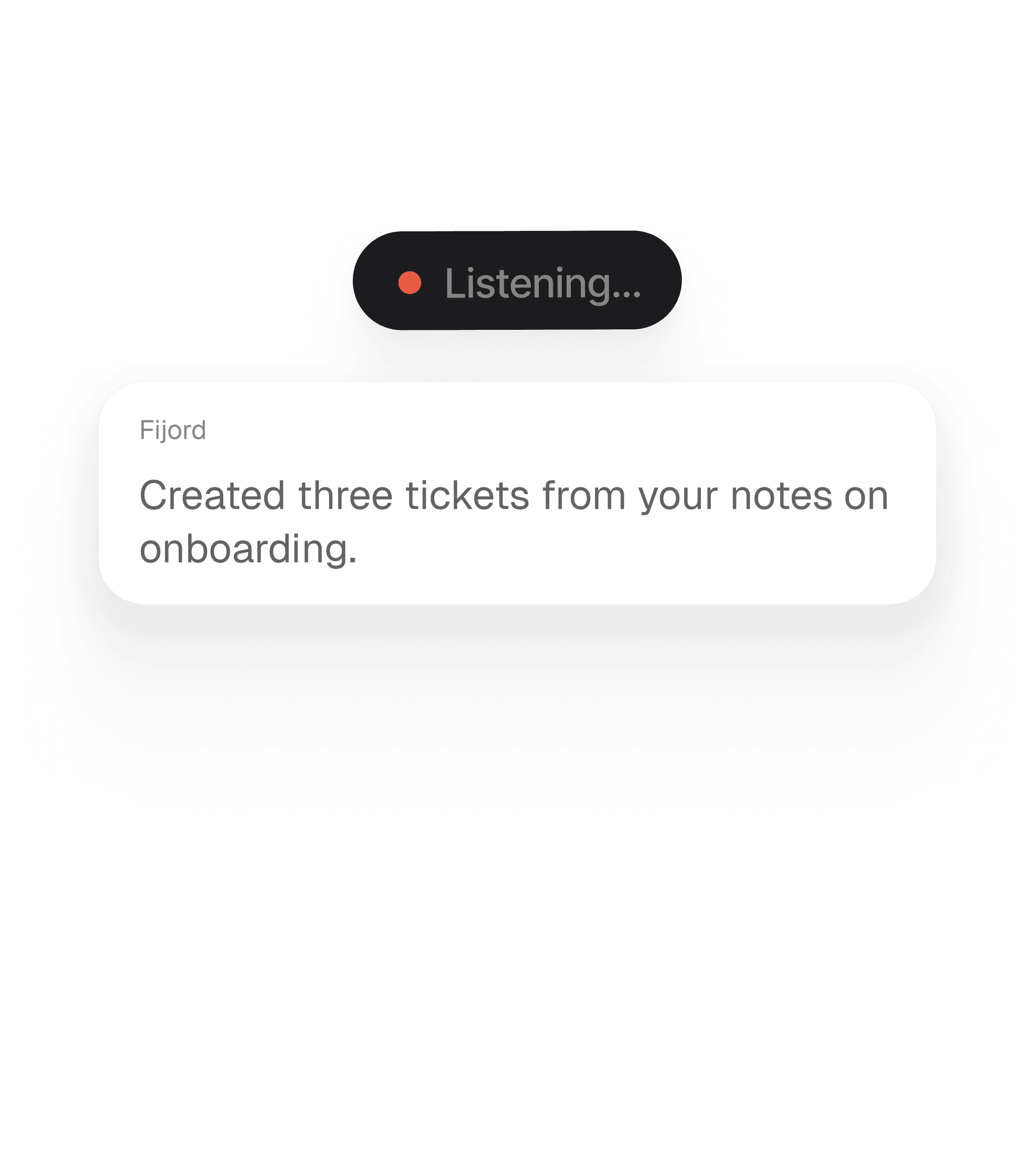
Talk, don’t type
Coming soon

Talk, don’t type

Speak a request. Fijord turns it into work.

Everything stays in sync
Coming soon

Everything stays in sync

Make a decision once. Fijord updates every related doc.

Switch views, not tools.

Start the day in Pulse, then move between Canvas, Kanban, Roadmap, and Impact Matrix, all built from the same evidence.

Fijord Pulse view

In the field

We talked to 100+ product managers. They kept saying the same six things.

01

The calendar eats the thinking

Between meetings, tickets, and stakeholder updates, product thinking gets whatever’s left.

02

Context lives in ten places

Notes here, analytics there, feedback somewhere else. Nobody holds the whole picture.

03

Nobody remembers why

Six months on, no one can say why a decision was made, or whether it worked.

04

Writing it up became the job

Tickets, PRDs, updates. Documenting the work has replaced the work.

05

You find out too late

Problems surface in a QBR instead of the week they started.

06

Shipping is treated as the finish line

Teams ship and move on. The outcome rarely makes it back into the next decision.

FAQ

Questions, answered

How Fijord works, how to get started, and what it can see.

The product

It doesn’t replace your existing tools. It connects the product feedback loop across them. Customer feedback, research, meetings, analytics, and delivery stay connected, so every decision is backed by evidence and measured by outcomes.

AI organizes information, surfaces patterns, answers questions, and automates product work. Every recommendation stays traceable back to the evidence behind it.

Every insight, recommendation, brief, and ticket links back to the conversations, documents, analytics, and research behind it, so you can check the source yourself.

Evidence keeps building on it, with a confidence level you can see. When you’re ready, turn it into an epic with briefs and tickets drafted from that evidence, or set a command to do it automatically once the signal reaches a threshold you choose.

Every recommendation comes with a predicted impact. After you ship, that prediction is compared with what actually happened in your analytics, and the result sharpens what gets recommended next.

Getting started

Connect the tools your team already uses and your product memory starts building. There’s nothing to migrate, and your team keeps working where it works today.

Modern product teams: product managers, designers, founders, engineering leaders, and researchers.

Meeting tools like Granola, Gong, Zoom, and Google Meet, plus Slack, Linear, Jira, Notion, GitHub, and Mixpanel. Once Jira or Linear is connected, tickets you approve sync straight into it. We’re adding more tools, so tell us what your team uses when you request early access.

Your data

Only the tools you connect. You choose which ones, you can disconnect any of them at any time, and reading stops the moment you do.

Only the tools you connect are read, and you can disconnect any of them at any time. We’re happy to walk your team through our security practices before you connect anything. Just ask when you request early access.

Only when you set it up to. Work is drafted and recommended, and you decide what happens next. Commands you create run on their own until you switch them off, and you can pause or remove them at any time.

Didn't find your answer? Ask us when you request early access.